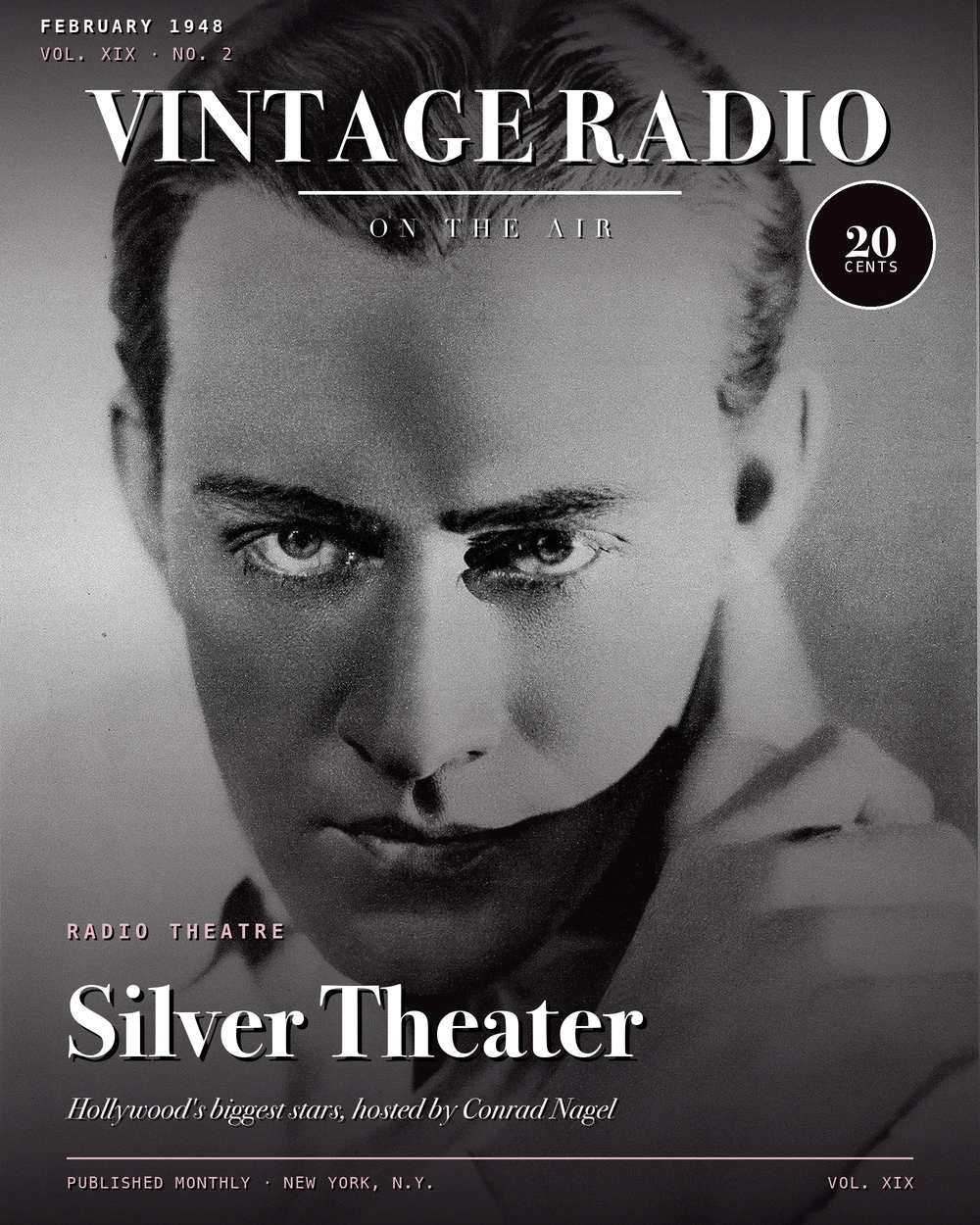
Silver Theater
How It Got on the Air
When Silver Theater premiered on October 3, 1937, the International Silver Company marked the occasion by inviting couples married 25 years or more to the CBS studio for the broadcast — a gesture that tied the show's emotional pitch to the domesticity and permanence its silverware was meant to represent. International Silver was a $20,000,000 company with subsidiaries worldwide, and it described the new show as by far its most ambitious undertaking.
The launch vehicle was a four-part story called First Love, running across four consecutive Sundays in October, with Rosalind Russell as a young woman trying to get a foothold in Hollywood and James Stewart as someone she met along the way. The premiere was announced as a new concept in radio drama, and screen scripter Grover Jones used stream-of-consciousness techniques that were then uncommon on radio. Stewart and Russell were asked to learn their lines and perform them at the microphone rather than simply read from scripts. Felix Mills was said to have composed a three-dimensional musical score, and sound effects were integrated with an unusual degree of care. The whole production aimed at what the promotional language of the time called "ultimate clarity."
The sponsor took the First Love branding further by launching an actual silverware line under that name — and declared on the air that Rosalind Russell herself had coined it. It was a seamless weave of drama and commerce that set the template for everything that followed.
The Show's Formula
Silver Theater's central idea was simple: take major Hollywood stars, build original scripts tailored to their established screen personas, and present them in 30-minute dramas. Occasional movie adaptations appeared, but the show's identity rested on those custom-written originals. The distinction mattered. Rather than repurposing existing material and hoping a big name would carry it, the writing staff — True Boardman, Grover Jones, Joseph Russell, and George Wells — shaped each script around what a particular actor did well on screen.
The weeks after First Love brought Cary Grant in Wings in the Dark, Helen Hayes in Stars in Their Courses, Clark Gable in Danger Lights, and Ginger Rogers in Son of the Navy. Over nine dramatic seasons the show produced 232 programs, and the guest roster grew to include Robert Montgomery, Ida Lupino, Maureen O'Sullivan, Herbert Marshall, Loretta Young, William Powell, and Judy Garland, among many others. The stories ran to heavy drama with intermittent comedies mixed in.
A Radio Varieties article from April 1940 described the production workflow in detail. The story department reviewed manuscripts, the agency's talent buyer contacted actors' representatives, and once a star was secured, host Conrad Nagel held a story conference with them. Adapter True Boardman or John Halloran would then write the script. From there, Felix Mills and his orchestra worked up the score, announcer Dick Joy timed the commercials, last-minute rewrites were made, sound effects were assembled, and a recorded dress rehearsal closed the process. William Powell, the article noted, spent the better part of an hour during his appearance playing with an electric train that had been set up as a sound effect for his broadcast.
Production was based in Hollywood, and the show carried on both CBS and the Canadian Broadcasting Corporation. Glenhall Taylor of Young & Rubicam served as producer-director during the earlier years, with Edna Best, Ted Bliss, and Walter Bunker producing in the mid-1940s. David Light handled sound effects throughout. Felix Mills and Jack Meakin alternated as orchestra leaders, and the announcer's chair passed through John Conte in the 1930s, Dick Joy in 1940, Henry Charles in 1941, and Roger Krupp, Jack Bailey, and Harry Bartell at various points.
Conrad Nagel and the Host's Role
Conrad Nagel was Silver Theater's face from the beginning — a film star from the silent era who brought recognizable Hollywood credibility to the CBS microphone. He received billing as the show's director, but the role was closer to what Cecil B. DeMille performed on The Lux Radio Theater: a front man whose name and manner set the tone rather than someone exercising creative control over production.
Nagel's biography lent the show institutional weight. Born in Keokuk, Iowa, in 1897, he was among the 35 film industry figures who founded the Academy of Motion Picture Arts and Sciences on May 11, 1927 — alongside Mary Pickford, Douglas Fairbanks, Richard Barthelmess, and Harold Lloyd. He served as AMPAS president from 1932 to 1933, resigning during a studio-labor dispute over Depression-era pay cuts. In 1940, the same year Silver Theater was cementing its reputation, he received an Honorary Academy Award for his work with the Motion Picture Relief Fund. He hosted the 3rd Academy Awards ceremony in 1930 and the 5th in 1932, then returned to co-host with Bob Hope at the 25th ceremony in 1953 — a 21-year gap between first and last Oscar-hosting appearances, a record. He was also a founding member of the Screen Actors Guild.
In the early 1940s, Nagel left Silver Theater to do a play in New York, and British actor John Loder took over as host, also carrying the misleading "director" billing. Loder was simultaneously married to Hedy Lamarr during his tenure, and his father, General W.H.M. Lowe, was the British Army officer to whom Patrick Pearse, leader of the 1916 Easter Rising, surrendered. Nagel returned for the three summer series that ran in 1945, 1946, and 1947.
The Sponsor Story
The show's formal identity was tangled up with its sponsor from the start. International Silver's flagship product line, 1847 Rogers Brothers silverware, gave the program one of its alternate on-air names — it was sometimes called The 1847 Silver Theater — and the company's marketing ran through the show at every level. In Life magazine, International Silver ran advertisements featuring product endorsements by Hollywood actresses, several of whom also performed on Silver Theater: Judy Garland, Carole Lombard, Ginger Rogers, Rosalind Russell, and Loretta Young all appeared in both contexts. The company's other brand, International Sterling, ran its own concurrent Life advertisements tied to the show.
The advertising worked. CBS was satisfied enough to run a four-page advertisement in the March 1, 1940, issue of Broadcasting magazine touting the show's effectiveness as a sales vehicle. That ad quoted International Silver directly: after thirteen weeks on CBS, "We find we can paint a more alluring picture … by radio than with the printed page," and after three years, sales of 1847 Rogers Bros. had increased every year. The ad added that "as the popularity of the program has increased, sales of 1847 Rogers Bros. have increased." CBS also produced a separate brochure documenting the show's success for the client. In a reversal of the usual flow, some of Silver Theater's original dramas were purchased for use as motion pictures — a sign that the scripts were regarded as having value beyond their promotional function.
International Silver of Canada mounted its own version on the CBC in 1941, though that production bore little resemblance to its American counterpart and lasted only 10 episodes. That same year, a Summer Silver Theater variety program ran on CBS from April 27 to September 28, with Ed Sullivan hosting and trombonist Will Bradley — born Wilbur Schwichtenberg — leading the orchestra.
The Final Seasons and the Format Shift
Silver Theater ran continuously on CBS from October 1937 through April 1942, returned for another full run from July 1943 through October 1944, and then came back for three summer stints in 1945, 1946, and 1947, filling in as a substitute for The Adventures of Ozzie and Harriet. International Silver sponsored all three phases.
The 1947 summer season brought a notable change: the Hollywood film star formula was abandoned, and radio performers were used instead. The new format let radio stars discuss their regular roles and then demonstrate their range in dramas different from their usual work. The first broadcast under this arrangement featured Staats Cotsworth, who played Casey on Casey, Crime Photographer, alongside Jay Jostyn, who played the lead on Mr. District Attorney, and Mary Jane Higby, who played Cynthia Swanson on The Romance of Helen Trent. A later broadcast brought Anne Elstner, known as Stella Dallas, and Virginia Payne, known as Ma Perkins, together in what Radio Life described as "two wacky old ladies in a whimsical comedy."
The final broadcast aired on August 17, 1947. The nine seasons had produced 232 dramatic programs, plus 23 variety programs under the 1941 summer run. Script and archival materials from 1935 through 1945 are held in the New York Public Library's Manuscripts and Archives Division.
After Radio
Silver Theater led directly to a television follow-up: The Silver Theatre, a CBS anthology that premiered October 3, 1949 — exactly twelve years after the radio show's debut — and ran through June 26, 1950. Nagel hosted again, and International Silver came back as sponsor. The series ran Monday evenings from 8 to 8:30 p.m., comprised 36 episodes produced by Jerry Fairbanks Productions, and was directed by Frank Telford, with Richard Stark announcing.
The TV version began as live broadcasts from WCBS-TV; its first filmed episode, My Brother's Keeper, aired on February 20, 1950, representing an early attempt to work past the limitations of kinescope. By early March, executives at Young & Rubicam had decided to film additional episodes on a large scale on the West Coast. Most episodes centered on "the humorous, silly, frustrating, futile, and rewarding aspects" of romance, and the series carried a monthly Silver Award presented by dramatic critics to the most deserving supporting performer. Guest stars included Hugh Beaumont, Ward Bond, William Frawley, Eva Gabor, Margaret Hamilton, Kim Hunter, Burgess Meredith, and George Reeves. The series was nominated for the Emmy Award for Best Film Made for Television at the 1950 ceremony, and later circulated in syndication under the title Marquee Theater and on ABC as Hollywood Half-Hour.
Nagel himself remained active long after both versions ended, hosting Celebrity Time on CBS and ABC from 1948 to 1952, Broadway to Hollywood on DuMont from 1953 to 1954, and the syndicated Conrad Nagel Theater in 1955. He had also hosted Radio Reader's Digest on CBS during Silver Theater's wartime hiatus, from 1942 to 1945. For his work across film, radio, and television, he received three stars on the Hollywood Walk of Fame.